Keyframe-oriented Vision Token Pruning:
Enhancing Efficiency of Large Vision-Language Models
on Long-Form Video Processing
Yudong Liu1, Jingwei Sun1, Yueqian Lin1, Jingyang Zhang1, Ming Yin1, Qinsi Wang1, Jianyi Zhang1, Hai Li1, Yiran Chen1
1Duke University · ICCV 2025
📄 Paper 💻 Code🚀 News
July 2025: Keyframe-oriented Vision Token Pruning: Enhancing Efficiency of Large Vision-Language Models on Long-Form Video Processing has been accepted at ICCV 2025! 🎉
Abstract
Vision-language models (VLMs) demonstrate strong capabilities in jointly processing visual and textual data. However, they often incur substantial computational overhead due to redundant visual information, particularly in long-form video scenarios. Existing approaches predominantly focus on either vision token pruning, which may overlook spatio-temporal dependencies, or keyframe selection, which identifies informative frames but discards others, thus disrupting contextual continuity.
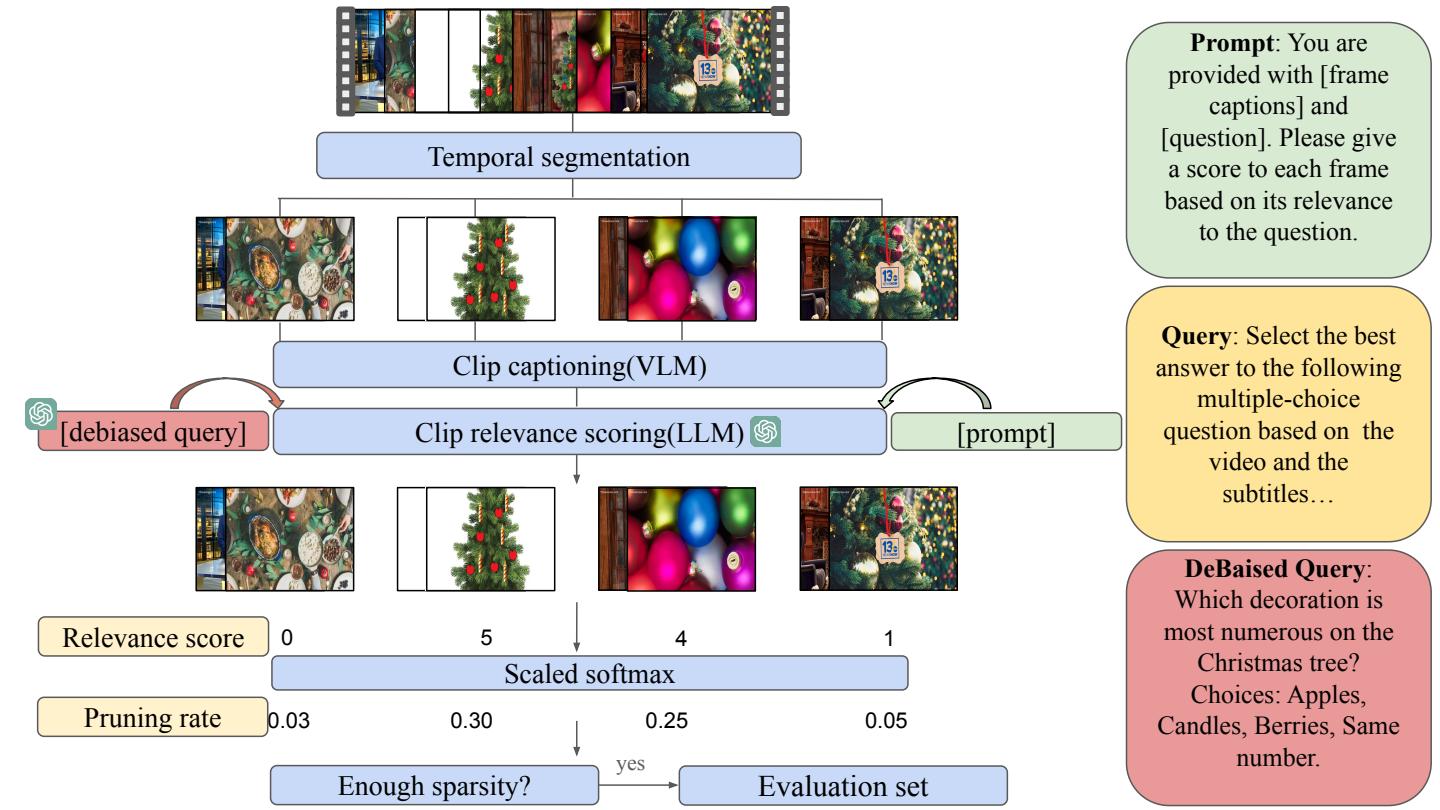
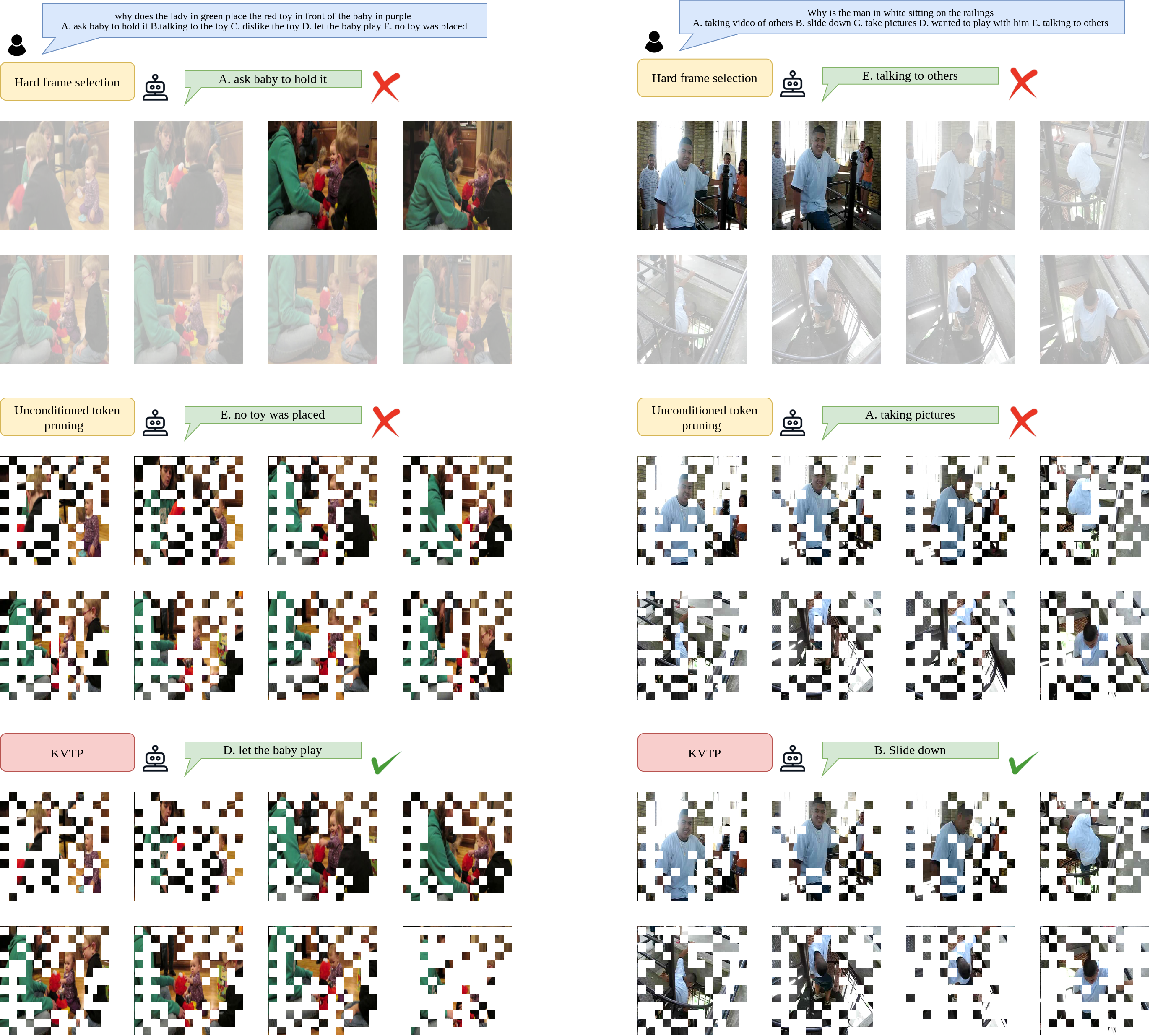
We propose KVTP (Keyframe-oriented Vision Token Pruning), a novel framework that overcomes the drawbacks of token pruning and keyframe selection. By adaptively assigning pruning rates based on frame relevance to the query, KVTP effectively retains essential contextual information while significantly reducing redundant computation. To thoroughly evaluate long-form video understanding capacities of VLMs, we curated and reorganized subsets from seven datasets into a unified benchmark that highlights real-world scenarios with sparse but crucial events.
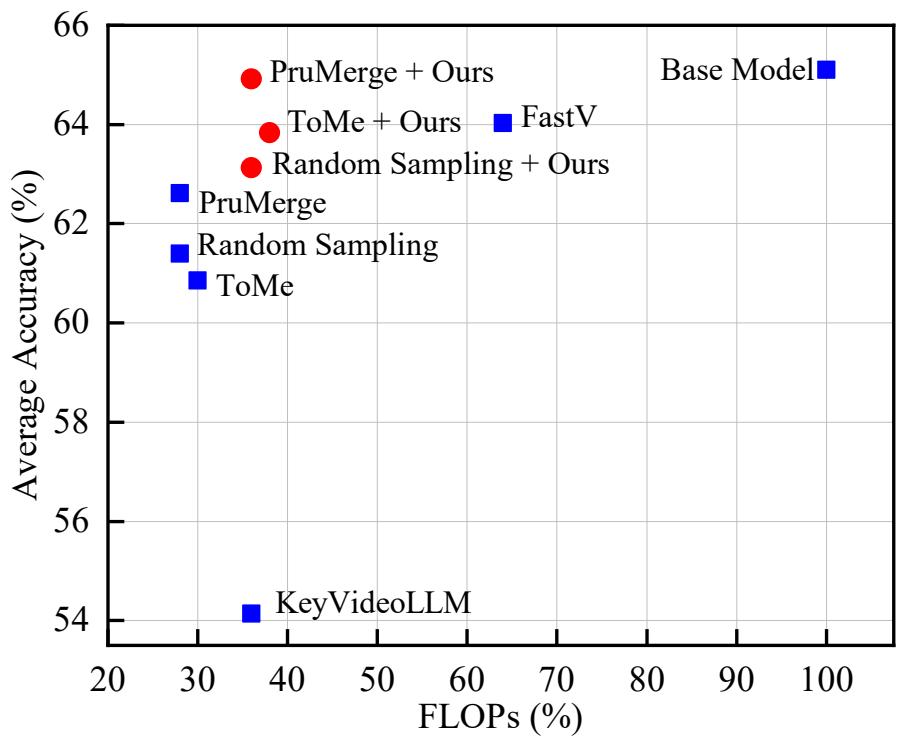
Experiments on VLMs of various scales show that KVTP can reduce token usage by 80 % while maintaining spatio-temporal and contextual consistency—cutting computation without sacrificing performance.
Method
SKV-QA Dataset Construction
We build SKV-QA, a training & evaluation benchmark for sparse-event, long-video QA by combining 7 open-source datasets (VideoMME, EgoSchema, NeXT-QA, …).
Frame Relevance Predictor & Token Pruning
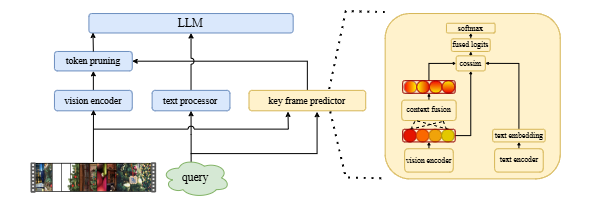
A lightweight frame relevance predictor is trained on SKV-QA and can be plugged into any existing token-pruning pipeline.
Results
LLaVA-Video-7B
| Method | FLOPs | VideoMME | EgoSchema | NeXT-QA |
|---|---|---|---|---|
| LLaVA-Video-7B | ×100 % | 62.63 | 54.17 | 78.51 |
| Random Sampling | ×36 % | 58.28 | 50.69 | 75.66 |
| ToMe | ×38 % | 59.21 | 51.83 | 72.49 |
| PruMerge | ×36 % | 59.97 | 52.76 | 75.88 |
| KeyVideoLLM | ×36 % | 51.32 | 46.78 | 64.33 |
| FastV | ×64 % | 61.79 | 52.42 | 77.89 |
| Random Sampling + KVTP | ×36 % | 60.16 | 52.73 | 76.50 |
| ToMe + KVTP | ×38 % | 62.36 | 53.24 | 75.88 |
| PruMerge + KVTP | ×36 % | 63.29 | 54.71 | 76.76 |
LLaVA-Video-72B
| Method | FLOPs | VideoMME | EgoSchema | NeXT-QA |
|---|---|---|---|---|
| LLaVA-Video-72B | ×100 % | 69.52 | 65.76 | 83.20 |
| Random Sampling | ×23 % | 62.57 | 60.55 | 79.03 |
| ToMe | ×23 % | 62.93 | 61.34 | 76.52 |
| PruMerge | ×23 % | 64.62 | 63.20 | 80.89 |
| KeyVideoLLM | ×23 % | 60.49 | 55.23 | 76.45 |
| FastV | ×56 % | 66.25 | 63.56 | 80.34 |
| Random Sampling + KVTP | ×23 % | 64.32 | 62.19 | 80.12 |
| ToMe + KVTP | ×23 % | 65.77 | 63.61 | 79.51 |
| PruMerge + KVTP | ×23 % | 67.34 | 64.12 | 81.21 |
Qualitative Examples
Citation
@inproceedings{liu2025kvtp,
  title     = {Keyframe-oriented Vision Token Pruning: Enhancing Efficiency of Large Vision-Language Models on Long-Form Video Processing},
  author    = {Liu, Yudong and Sun, Jingwei and Lin, Yueqian and Zhang, Jingyang and Yin, Ming and Wang, Qinsi and Zhang, Jianyi and Li, Hai and Chen, Yiran},
  booktitle = {Proceedings of the IEEE/CVF International Conference on Computer Vision (ICCV)},
  year      = {2025}
}